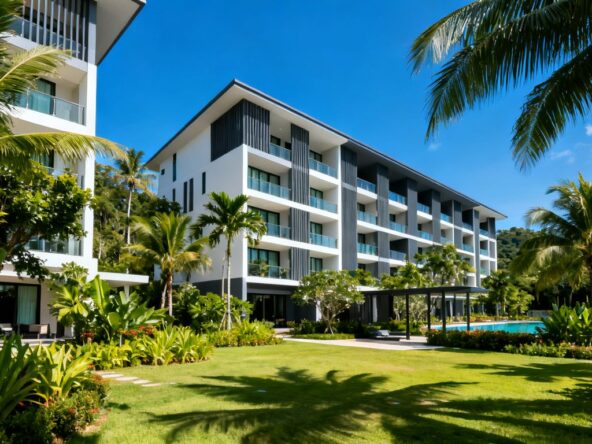


Thailand’s property market is navigating its most severe downturn in nearly 30 years, with experts predicting a prolonged period of adjustment through 2025 and 2026. A confluence of high household debt, tightening credit conditions, and a sluggish economy has led to a significant drop in purchasing power, particularly affecting the mass-market segment. Developers are increasingly shifting focus to luxury properties and niche strategies to weather the storm.
Key Takeaways
- The market faces its worst slowdown since the 1997 financial crisis.
- Unsold condominium stock is at an all-time high, with 400,000 units nationwide.
- Mortgage rejection rates for homes under 3 million baht have reached 70%.
- Developers are pivoting from mass-market to luxury segments.
- Industrial and logistics real estate shows resilience due to foreign direct investment.
A Market in Crisis
The Thai real estate sector is grappling with an unprecedented slowdown, marked by a sharp decline in new project launches and a surge in unsold inventory. Experts suggest this is not merely a cyclical dip but a prolonged adjustment period, with recovery uncertain in the short to medium term. The International Monetary Fund’s forecast of a mere 1.6% economic growth for Thailand in 2026 underscores the deep structural issues impacting the market.
The Unsold Inventory Glut
A critical concern is the vast stock of unsold residential properties, estimated at 400,000 units nationwide, with Bangkok alone accounting for 220,000 condominiums. These unsold units represent a significant financial burden for developers, incurring costs such as loan interest, holding expenses, and upcoming bond repayments. New condominium launches in Bangkok have plummeted, with projections indicating a continued decrease in supply over the next few years, signalling a long-term defensive stance by developers.
Interest Rate Hikes and Tightened Credit
The current crisis is largely attributed to rapid expansion during a low-interest-rate period, followed by aggressive interest rate hikes by the Bank of Thailand. This has increased borrowing costs significantly, while high household debt—standing at 88.2% of GDP—has prompted commercial banks to tighten lending standards. Consequently, mortgage rejection rates have soared, particularly for properties priced below 3 million baht, with some developers reporting rejection rates as high as 70%.
A Tale of Two Markets: Luxury vs. Mass
A stark divide is emerging between the luxury and mass-market segments. While the mass-market faces a "Mortgage Rejection Crisis," the high-end market, catering to affluent buyers less reliant on financing, remains relatively stable. Developers are increasingly retreating from affordable housing to focus on luxury properties. However, even the luxury segment is showing signs of weakness, with a significant supply of unsold high-value homes.
Glimmers of Hope: Industrial Property and Regional Growth
Despite the overall downturn, certain sectors and regions show promise. The industrial and logistics real estate sector is performing well, buoyed by strong foreign direct investment (FDI). Additionally, areas outside Bangkok, such as Phuket, Pattaya, Koh Samui, Hua Hin, and Sriracha, are showing brighter prospects, particularly in the Eastern Seaboard region, driven by industrial growth and expatriate communities.
Path to Recovery
For the Thai property market to stabilise, experts recommend a multi-pronged approach. This includes political stability, effective property tax reforms for vacant properties, increased infrastructure investment, and measures to reduce household debt. A reduction in interest rates is also seen as crucial. The market’s recovery hinges on a broader economic rebound and strategic adaptation by developers to focus on niche markets and quality offerings.
Sources
- Thai Property Market Faces Worst Slowdown in Nearly 30 Years, Nation Thailand.
- Thailand Property Market Faces ‘Mortgage Rejection Crisis’ as Mass Buyers Struggle to Secure Loans, Nation Thailand.
- The 150 Billion Baht Time Bomb: Thailand’s Condo Sector Braces for Liquidity Crunch, Nation Thailand.
- Thai Property Market Faces Toughest Challenge in Decades as 2026 Looms, Nation Thailand.
- Thailand’s Property Market Faces Extended Slowdown as Developers Urged to Embrace Niche Strategies, Nation Thailand.