
For anyone watching Phuket property development, the detail behind the headline matters more than the announcement itself. Phuket has committed more than B1.03 billion to expand its power grid with five new substations by 2029. The reason is practical: the island already consumes more electricity than any other province in southern Thailand, and demand is projected to climb nearly 60% over the next decade.
The Provincial Electricity Authority (PEA) Phuket office reports current electricity use at 573 megawatts, ahead of Songkhla at 555MW, Surat Thani at 476MW and Nakhon Sri Thammarat at 371MW. By 2036, Phuket’s demand is expected to reach around 900MW, driven by continued expansion in tourism, real estate development and the services sector.
What this means for property buyers, developers and investors is straightforward: electricity capacity is now a bottleneck that shapes where development can happen, how quickly it can scale, and whether existing infrastructure can support new supply without strain.
Why electricity capacity matters for Phuket development
Wissnu Masphermpong, Deputy Manager of the PEA Phuket office, confirmed that electricity capacity has become a formal requirement for business licensing on the island. Operators must demonstrate adequate supply before receiving approval to operate.
“Businesses must obtain certification confirming that there is sufficient load capacity and a stable electricity system before they can apply for licences,” he said. “This means we must continuously review usage data and overall system capacity.”
In plain English, if the grid cannot support a new development, the development does not proceed. The implication for property markets is direct: without expanded capacity, supply constraints tighten. New hotel projects, villa estates, shopping centres and mixed-use developments all depend on reliable electricity access.
The PEA’s substation rollout is designed to remove that constraint in key growth areas.
Where the new substations will be located
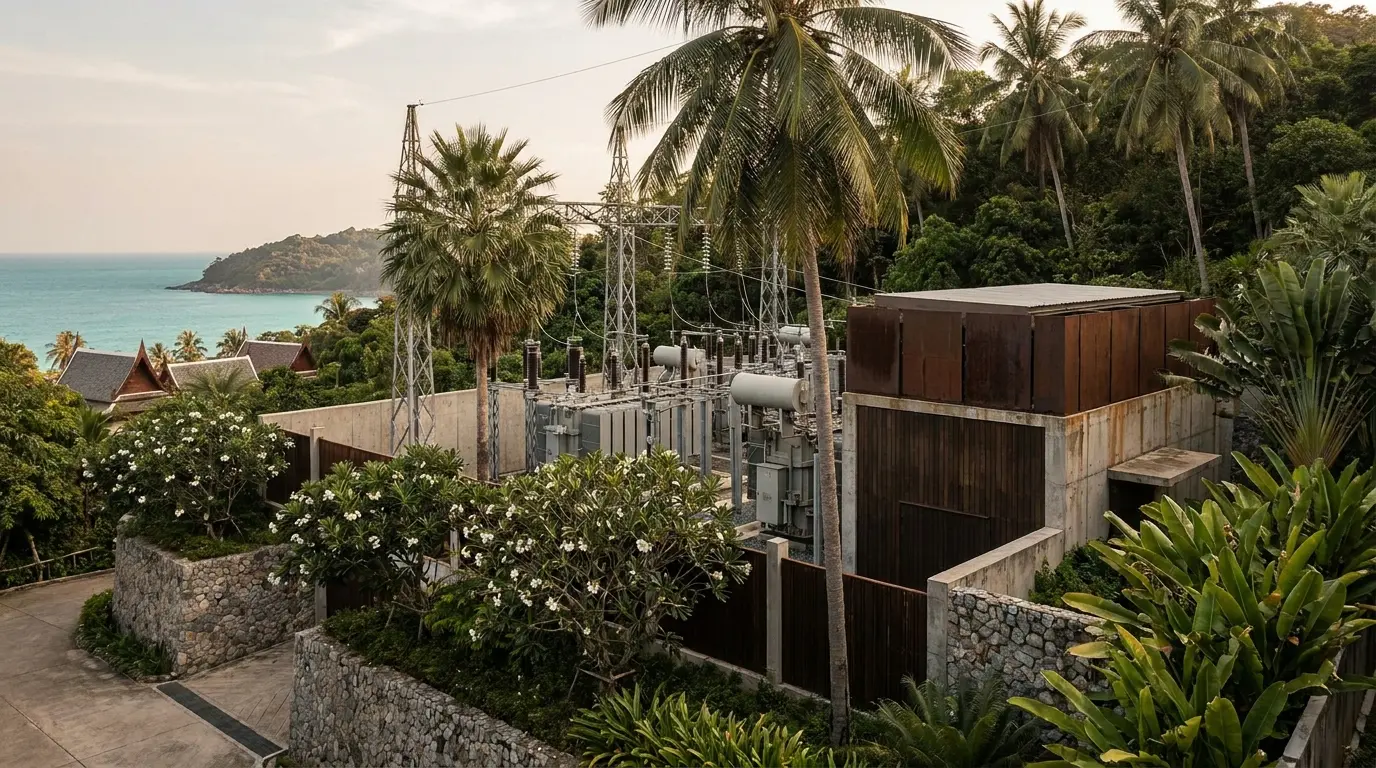
Phuket currently operates 11 substations. The first of the five planned additions came online on 6 May in Kathu, near Prince of Songkla University. It is equipped with two 50-megavolt-ampere transformers, providing around 100MW of capacity.
Three more substations are scheduled for completion in 2027:
- Kamala, positioned near the hill descent from Patong
- Rawai, serving southern Phuket including Kata, Karon and Sai Yuan
- Laguna in Cherng Talay, one of Phuket’s fastest-growing development corridors
A fifth substation is planned for Phuket Town in 2029.
The locations are notable. Laguna and Cherng Talay are already recognised as high-demand areas with significant hotel, villa and residential expansion. Rawai and surrounding southern districts have seen rapid residential and tourism growth. Kamala sits between Patong and the northern west coast corridor.
Each location reflects areas where electricity demand has either outpaced capacity or is expected to do so within the next few years.
The Patong capacity problem
The urgency behind the expansion is clearest in Patong, one of Phuket’s busiest tourism zones. The existing Patong substation is currently operating at more than 80% of its capacity.
“Operating at that level is risky and could lead to transformer issues,” Mr Wissnu said. “The Kathu substation will help reduce that load. Initially, it will operate at around 30-40% capacity, and then gradually increase as demand grows.”
For buyers or investors comparing new developments in Patong with those in other areas, the detail is worth noting. High capacity utilisation creates operational risk. It can lead to outages, flickering and system instability, all of which affect hotels, restaurants, retail and residential properties.
The Kathu substation now redistributes load from Patong and Phuket Town while reserving capacity for future demand. The practical effect is that Patong’s infrastructure pressure is being eased, and new developments in central Phuket have more headroom.
Long-distance transmission risk in Cherng Talay
The planned Kamala and Laguna substations address a different problem. Much of the electricity supply to Cherng Talay is currently transmitted from Patong via long-distance lines.
“These transmission lines create risks due to terrain and potential natural disasters, which can affect system stability,” Mr Wissnu said. “By having a substation closer to the demand area, we can significantly improve stability and reduce flickering and outages.”
For property buyers considering villa estates or long-term residences in the Laguna area, the change matters. Closer substation proximity reduces transmission distance, improves grid stability and lowers the risk of weather-related outages. It also signals that the area has been prioritised for infrastructure investment, which typically correlates with sustained development activity.
What the demand projection tells us
The PEA’s forecast of 900MW demand by 2036 represents a 57% increase from current levels. The projection is based on continued expansion in tourism, real estate and services.
Wissnu Masphermpong noted that business growth has accelerated significantly since the COVID-19 period, which has pushed demand higher. The PEA forecasts load increases annually and determines where new substations are required based on areas where demand is rising fastest.
For Phuket property markets, the implication is that infrastructure planning now assumes sustained growth over the next decade. The B1bn commitment is not speculative. It is a response to current strain and expected demand.
The practical consequence for buyers is that areas receiving new substations are areas where development is expected to continue, where grid stability will improve, and where capacity constraints are being actively removed.
The wider context for Phuket real estate
Electricity infrastructure is rarely discussed in property marketing, but it shapes supply, timing and location more directly than most buyers realise. Without adequate capacity, new projects cannot launch. With capacity constraints, development concentrates in areas where infrastructure exists. With capacity expansion, new areas open up.
The PEA’s rollout signals that Phuket’s infrastructure is being expanded to support continued real estate and tourism growth. The locations chosen—Laguna, Kamala, Rawai, Kathu and Phuket Town—reflect where demand pressure is highest or where future expansion is anticipated.
For buyers comparing different areas, the detail is useful. Infrastructure investment often precedes or accompanies property price appreciation, particularly in growth markets. It also reduces operational risk for rental properties, hotels and long-term residences.
The broader point is that Phuket’s electricity demand already leads southern Thailand, and the gap is expected to widen. That reflects the island’s economic role, but it also reflects a development pattern that depends on stable, high-capacity infrastructure. The B1bn substation push is designed to ensure that infrastructure keeps pace.
Frequently Asked Questions
Why does Phuket use more electricity than other southern provinces?
Phuket’s 573MW consumption is the highest in southern Thailand due to its role as a major tourism and commercial hub. The island’s high concentration of hotels, resorts, restaurants, shopping centres and residential developments creates demand that exceeds larger but less economically dense provinces such as Songkhla and Surat Thani.
Will the new substations affect property development in Laguna and Cherng Talay?
Yes. The planned Laguna substation is intended to support one of Phuket’s fastest-growing development corridors. Currently, electricity is transmitted from Patong via long-distance lines, which creates stability risks. The new substation will improve grid reliability and reduce capacity constraints, making it easier for new developments to proceed.
What happens if electricity demand grows faster than expected?
The PEA forecasts demand annually and adjusts infrastructure plans accordingly. Some of the new substations may initially operate as temporary facilities before being upgraded to permanent installations as demand increases. The Kathu substation, for example, is currently operating at 30-40% capacity with room to scale.
Does electricity capacity affect property prices in Phuket?
Infrastructure investment typically correlates with development activity and demand growth, which can support property price appreciation. Areas receiving new substations are areas where grid stability improves, capacity constraints are removed, and development is expected to continue. Buyers often see these areas as lower-risk for long-term investment.
When will the Rawai and Laguna substations be completed?
The PEA has scheduled the Rawai, Laguna and Kamala substations for completion in 2027. A fifth substation in Phuket Town is planned for 2029. The Kathu substation came online in May 2025.
Sources
- The Phuket News — Power Play: Phuket tops South in demand, rolls out B1bn substation push — link