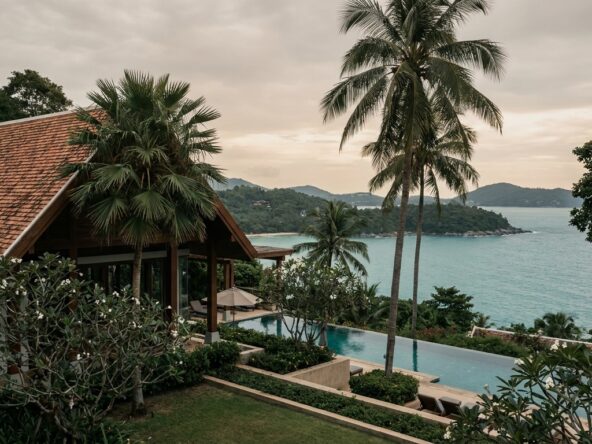

There is a conversation that happens in thousands of investor offices every quarter. A promising property listing appears—oceanfront Phuket villa, rental projections that look solid, price per square meter that seems reasonable against comparable markets. Then someone asks the question that changes everything: “But what do we actually own when we buy in Thailand?”
The silence that follows is expensive. Not because the answer is unknowable, but because most buyers realize they are about to spend seven figures on something they do not fully understand.
The Real Problem Under the Surface
Foreign property acquisition in Phuket is not complicated because Thailand makes it deliberately difficult. It is complicated because three separate ownership frameworks exist simultaneously, each with different legal protections, different risk profiles, and different implications for resale value. Most marketing materials present one framework as if it were the only option.
That is not guidance. That is sales copy.
The ownership structure you choose dictates everything that follows: your legal standing, your financing options, your exit strategy, and whether your children can inherit the asset without triggering a forced sale. These are not details to figure out after you fall in love with a property. They are the foundation of the entire investment thesis.
What Experienced Phuket Investors Actually Track
Investors who have successfully acquired and held Phuket property for 5+ years track a different set of metrics than first-time buyers. They are not looking at headline rental yields or developer projections. They are watching:
- Liquidity depth by submarket — How many comparable properties sold in the past 90 days, at what average days-on-market, and whether buyers paid asking or negotiated down
- Ownership structure prevalence — What percentage of recent sales in a given development used freehold foreign quota versus leasehold versus Thai entity structures, and what that signals about buyer confidence
- Post-completion occupancy rates — Not projected yields from the sales office, but actual verified rental income from properties that completed 12-24 months ago in the same development
- Management company stability — Whether the property management firm has been operating continuously for 3+ years with the same operational team, or whether it is a new entity spun up by the developer
These are not metrics you find in a glossy brochure. They require on-the-ground intelligence and access to transaction data that most buyers never see. This is where the Foreign Buyer’s Due Diligence Framework becomes indispensable—it walks through the exact 23 checks that separate informed acquisitions from expensive lessons.
The Three Ownership Structures Decoded
Thailand permits foreign property ownership through three primary frameworks. Each comes with different cost structures, different legal protections, and different implications for long-term value. Understanding which one fits your situation is not a matter of preference—it is a matter of matching legal reality to investment objectives.
Freehold Foreign Quota Ownership
This is the structure most foreign buyers want: direct freehold ownership in your own name, with the same legal standing as any Thai national who owns property. The constraint is availability. Thai law limits foreign ownership to 49% of the saleable area in any condominium building. Once that quota is exhausted, it is gone—no amount of negotiation changes the math.
What this means in practice: units in buildings where the foreign quota is still available trade at a premium, sometimes 15-20% above identical units that must be sold under leasehold or Thai entity structures. That premium is not arbitrary—it reflects the market’s recognition that freehold ownership carries lower long-term risk and higher resale liquidity.
Leasehold Structures
A 30-year registered lease grants you control and use of the property, with the option to renew for two additional 30-year terms (subject to the landowner’s agreement at the time of renewal). This structure is often presented as “90-year ownership,” which is technically accurate but legally misleading. The initial 30-year term is the only one with enforceable legal standing. The renewals are contractual options, not guarantees.
Leasehold works well for buyers who plan to use the property themselves for 10-20 years and are not building a multi-generational asset. It works poorly for investors who need liquidity or who want to pass the asset to heirs without triggering a renegotiation with the freeholder.
Thai Majority Company Ownership
Some buyers are advised to set up a Thai limited company with nominee shareholders to hold property in their name. This structure is legal on paper but exists in a grey zone. Thai law requires that Thai shareholders in such companies hold genuine economic interest—they cannot simply be paid nominees. Enforcement is inconsistent, which means the structure is tolerated until it is not.
Experienced investors avoid this route unless they have legitimate business operations in Thailand that justify the corporate structure. The risk is not theoretical: Thai authorities have invalidated nominee structures in high-profile cases, forcing sales under distressed conditions.
Pricing Trends That Matter More Than Headline Numbers
Phuket property prices are not uniform. Headline statistics that report “Phuket luxury real estate up 8% year-on-year” obscure more than they reveal. What matters is granular submarket performance, segmented by location, ownership structure, and property type.
In 2024, we observed three distinct pricing dynamics:
- Oceanfront freehold condominiums in the Kamala-Surin corridor appreciated 12-15%, driven by limited supply and sustained demand from European and Australian buyers.
- Leasehold pool villas in Rawai-Nai Harn saw flatter pricing, with longer days-on-market and increased negotiation leverage for buyers. The issue was not demand—it was that developers overbuilt in this segment during 2021-2022.
- Properties held under Thai entity structures faced a liquidity discount of 10-18% compared to equivalent freehold units, reflecting buyer caution around legal risk.
These are not predictions. They are verified transaction patterns from completed sales. Understanding them allows you to avoid overpaying in soft segments and recognize genuine value in tight ones.
The Infrastructure Question No One Asks Early Enough
Infrastructure is not roads and airports. Infrastructure, in the context of foreign property ownership, is the network of professional services that stand between you and a problem when something goes wrong. This includes: legal counsel who specialize in foreign ownership structures, property managers with multi-year operational track records, accounting firms that handle annual Thai entity compliance, and real estate agents who have closed 50+ transactions in your target submarket.
Most buyers discover the importance of this network only after acquisition, when they need someone to resolve a title issue or negotiate with a difficult tenant. By then, it is too late to build those relationships from a position of strength.
The investors who succeed in Phuket are the ones who establish these connections before they sign a sales contract. They verify that the property they are considering comes with access to institutional-grade support, not just a contact number for the developer’s sales office.
What Post-Purchase Support Actually Looks Like
Post-purchase support is not a customer service line you call when the air conditioning breaks. It is ongoing access to the same infrastructure that made the acquisition possible: legal review when renewing a lease, accounting support for annual tax filings, property management that handles tenant turnover without requiring your involvement, and market intelligence that tells you when it is time to sell or refinance.
Properties sold by firms with established post-purchase frameworks hold value better than properties sold by developers who disappear after closing. This is not subjective—it shows up in resale data. Buyers pay more for properties where they know the operational burden is managed by competent professionals.
How to Identify Signal in a Noisy Market
Phuket’s property market is saturated with marketing content. Developer presentations, agent listings, investment seminars—all of it blurs together into a wall of projected yields and lifestyle photography. Separating signal from noise requires a framework. Ask these questions about any property you are considering:
- What percentage of units in this development sold in the past 12 months, and what was the average discount from original asking price?
- How many years has the property management company operated, and can they provide verified rental income data from comparable units?
- Is the foreign ownership quota still available, and if not, what ownership structure am I actually being offered?
- What is the liquidity profile of this submarket—how many days does it typically take to sell a comparable property?
- Who will handle title transfer, lease registration, and ongoing compliance, and what is their track record?
If the agent or developer cannot answer these questions with specificity, you are talking to the wrong person. This is where having access to the full Due Diligence Framework gives you the language to separate expertise from sales patter.
The Informed Acquisition Path
Buying property in Phuket as a foreign national is not a matter of courage or timing. It is a matter of information architecture. You need to know what you are legally acquiring, what the market will pay for it in 5-7 years, and who will manage the operational complexity between now and then.
The investors who get this right are not the ones who move fastest or negotiate hardest. They are the ones who ask the difficult questions early, verify every claim, and build relationships with professionals who have seen multiple market cycles. They treat due diligence not as a box-ticking exercise, but as the foundation of the entire investment thesis.
That approach does not make for exciting sales presentations. But it makes for confident ownership, backed by infrastructure that actually works when you need it. And in a market where the difference between informed and uninformed buyers shows up in six-figure price disparities, that confidence is worth considerably more than any rental projection.
Ocean Worldwide Real Estate serves foreign buyers navigating Phuket’s property market. If you would rather not decode ownership structures and market intelligence on your own, this is what we are here for.