

For Phuket property buyers and investors watching capital flows in Southeast Asia, a significant shift in Singapore deserves attention. Chinese developers and business entities have become one of the largest sources of property investment in Singapore, with their share of total fixed-asset investment jumping from 2.5% in 2024 to 21% in 2025, according to a February report from the Singapore Economic Development Board.
The total investment across all sectors reached S$14.16 billion (US$11.07 billion), with Chinese entities becoming the second-biggest investors after Europe.
This matters because capital allocation in Southeast Asia rarely happens in isolation. When Chinese developers and investors shift significant resources to one regional market, it affects appetite, pricing pressure and buyer confidence elsewhere, including resort and lifestyle property markets such as Phuket.
What the numbers show
Chinese-linked developers and business groups have been active in Singapore’s land market. Notable transactions in 2024 and early 2025 include:
A 145,500-square-foot lot on Dover Drive, acquired by CNQC Realty (Prime), Forsea Residence and Jianan Realty Investments for S$951 million at the end of the first quarter of 2025. The site is expected to yield 625 residential units.
A 222,161-square-foot plot called Lentor Gardens, won by Kingsford Huray in April 2024 for S$429.23 million, expected to yield residential units in the Lentor Hills estate.
A 147,350-square-foot plot on Telok Blangah Road, acquired by Kingsford Group in November 2024 for S$918.3 million. Together with the Lentor Gardens site, the parcels are expected to yield more than 1,240 units.
A parcel on Bayshore Road, purchased by SingHaiyi Group and Haiyi Holdings in March 2024 for S$658.9 million, expected to yield 515 units.
According to Alan Cheong, executive director for research and consultancy at Savills Singapore, Chinese developers who have gained experience in Singapore are now familiar with the rules, regulations and market behaviour. They are expected to continue bidding to replenish their landbanks.
Why Chinese developers favour Singapore
Singapore’s safe-haven status continues to attract global capital. The city-state offers regulatory clarity, rule of law, ease of asset seizure for creditors, and a transparent property market with consistent demand.
Gary Ng, senior economist for Asia-Pacific at Natixis CIB, noted that foreign assets can help limit losses for international creditors, providing easier seizure of assets if needed in cases of default. However, he pointed out that overseas asset sizes remain small relative to overall liabilities, and poorly executed projects may exert more pressure on developers.
Residential projects are typically built for sale, with returns realised over a shorter development cycle. This contrasts with commercial projects, which are often undertaken with long-term rental income strategies in mind, according to Wong Xian Yang, head of research for Singapore and Southeast Asia at Cushman & Wakefield.
Interest from mainland groups and their affiliates has increased bidding activity for Government Land Sales programme sites, with average bidders rising to 5.35 per site in 2025 from three in 2024, according to Cushman & Wakefield.
The wider Southeast Asia context
While Phuket and Singapore serve different buyer segments and operate under different ownership structures, both compete for attention within the same regional investment universe. Singapore attracts institutional capital, developers and family offices. Phuket attracts lifestyle buyers, rental investors and long-stay residents.
The key point is that when Chinese capital commits heavily to Singapore land acquisition and development, it signals confidence in Southeast Asia as a whole. It also suggests that Chinese buyers and developers are prioritising safe-haven markets with clear legal structures and exit strategies.
For Phuket, the question is not whether Chinese capital will disappear entirely, but whether the profile of Chinese buyers shifts. Developers seeking landbanking opportunities in Singapore may have less appetite for speculative resort villa purchases in Thailand. Individual buyers seeking secure, liquid assets may favour Singapore’s freehold condominiums over Thai leasehold structures.
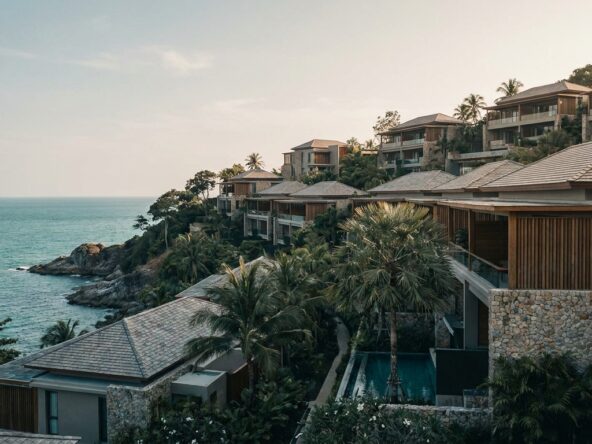
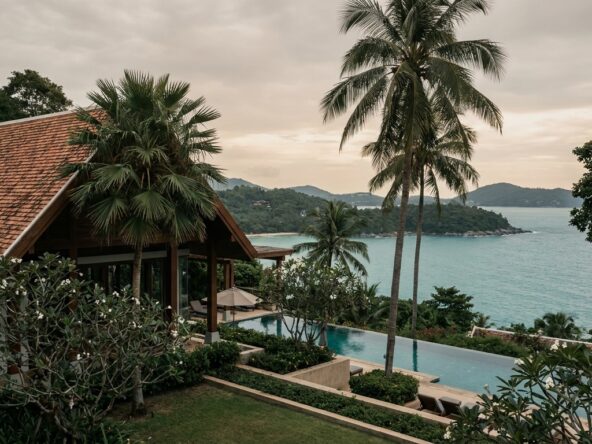
However, Phuket continues to offer what Singapore cannot: beachfront access, lower entry prices, villa product, rental yield from tourism demand, and lifestyle appeal for long-stay residents. These remain distinct advantages for buyers whose priorities differ from institutional developers.
What remains unclear
The Singapore report does not break down whether the 21% share includes individual Chinese buyers, family offices, private investment groups or purely mainland developers. The distinction matters because developer capital and individual buyer capital behave differently.
It is also unclear whether the surge in Chinese investment in Singapore represents a reallocation from other Southeast Asian markets or an increase in total outbound capital. If Chinese buyers are reducing exposure to Thailand, Malaysia or Vietnam in favour of Singapore, that would have direct implications for Phuket demand. If the increase reflects new capital entering the region, the impact on Phuket may be neutral or even positive.
Finally, the report does not indicate whether the trend will continue in 2026. Chinese capital flows are subject to policy changes, currency controls, economic conditions and shifts in domestic real estate confidence. A policy tightening or domestic market recovery could reverse the trend quickly.
Frequently Asked Questions
Does Chinese investment in Singapore affect Phuket property demand?
It may. When Chinese capital commits heavily to Singapore, it signals changing priorities. Developers focused on landbanking in Singapore may have less appetite for speculative resort villa purchases in Phuket. However, individual lifestyle buyers seeking beachfront access, rental yield and lower entry prices may still favour Phuket.
Why do Chinese developers prefer Singapore over other Southeast Asian markets?
According to analysts cited in the report, Singapore offers regulatory clarity, rule of law, transparent property markets and easier asset seizure for creditors in cases of default. Residential projects also offer shorter development cycles and faster return realisation compared to commercial projects.
What advantages does Phuket still offer compared to Singapore?
Phuket offers beachfront access, villa product, lower entry prices, rental yield from tourism demand, and lifestyle appeal for long-stay residents. These remain distinct advantages for buyers whose priorities differ from institutional developers focused on urban land acquisition.
Is the surge in Chinese investment in Singapore a permanent shift?
That remains unclear. Chinese capital flows are subject to policy changes, currency controls, economic conditions and shifts in domestic real estate confidence. A policy tightening or domestic market recovery could reverse the trend quickly.
Does the report indicate whether Chinese buyers are reducing exposure to Thailand?
No. The report does not break down whether the 21% share represents a reallocation from other Southeast Asian markets or an increase in total outbound capital. If Chinese buyers are reducing exposure to Thailand in favour of Singapore, that would have direct implications for Phuket demand.
Sources
- Bangkok Post — Singapore’s safe-haven status draws more Chinese capital into property sector — link
- Singapore Economic Development Board — February 2025 report on fixed-asset investment