

For Phuket property buyers, the question is not only whether a location looks good in January. The question is whether it stays occupied in September. Rawai, at Phuket’s southern tip, has drawn foreign residents for more than forty years. The fishing pier still operates, the seafood market opens early, and the streets stay busy outside high season. That last detail matters more than most of the others. The district runs on two demand streams. The first is long-stay families and relocators who live there year-round, drawn by the international schools one to two kilometres away. The second is high-season visitors heading for Nai Harn beach, seven minutes away and regularly ranked among the ten best beaches in Southeast Asia. An owner letting a unit in Rawai is therefore not betting everything on a four-month window. That structural difference is why the district keeps appearing on investor shortlists.
Ocean Worldwide field note
Our own brokers work the west coast – Cherngtalay, Layan and Bang Tao – so we will not pretend to know Rawai street by street. What we can tell you is that the pattern described here is the same one we watch on our own patch. Properties in walkable, year-round locations hold their occupancy through the shoulder season. Average stock in remote spots struggles badly between May and October. Bang Tao and Layan are the current outperformers for exactly that reason. A district with two demand streams underneath it, like the one this article describes, is the feature we tell buyers to look for, wherever on the island they end up.
The questions that decide whether a purchase works
Search for rental returns in southern Phuket and you will see projects with percentages attached. The percentage is the easy part. The harder questions are:
- Can a foreigner own the unit outright, or only lease it?
- Is the return a contractual obligation or a marketing figure?
- How long does the guarantee run, and what happens when it ends?
- Who maintains the building fifteen years after handover?
Next Point Condominium & Radisson Serviced Apartments Rawai Phuket, now under construction in Rawai, answers all four in specific terms.
What the project offers
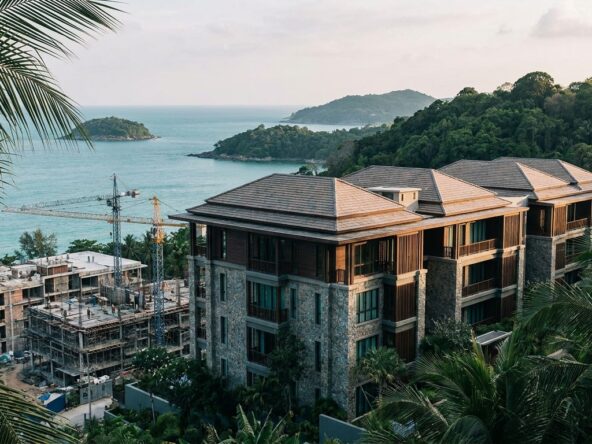
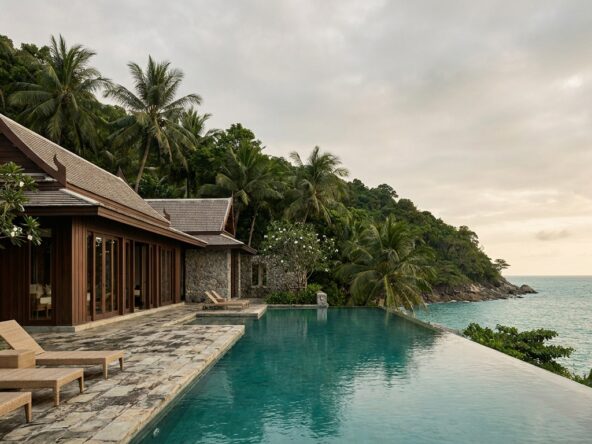
Next Point Condominium is a four-building, 372-unit development on a five rai site, completing in the fourth quarter of 2028. Construction started on 8 December 2025. The building permit came through in October 2025, the Environmental Impact Assessment was approved, and the land is held under Chanote title. The four buildings are laid out in an X. According to the developer, 90% of the apartments have views of the sea, the tropical greenery behind the site, or the Big Buddha. Andaman views open up from the third floor. One of the four buildings operates as Radisson Serviced Apartments Rawai Phuket, with 118 keys managed by Radisson Hotel Group. The other three are conventional condominium buildings.
Two ownership options, two different purchases
The Radisson building is leasehold only. The apartments are run as serviced units to hotel standard. The owner is not managing anything: no tenant search, no seasonal decisions, no maintenance coordination. The operator handles the asset and the owner receives the income. At resale, an internationally recognised operator is something the next buyer already understands without explanation. In a market crowded with unbranded stock, that clarity carries weight. The other three buildings are conventional condominiums. Foreign buyers can hold freehold within Thailand’s standard foreign quota, and leasehold is available in those buildings too. Freehold means a home rather than a serviced unit, with the freedom that implies: how you furnish it, when you use it, whether you let it at all. What the buildings share is the operating standard. Buildings 1 to 3 are run by their own management company, working to the service and maintenance standards set for the Radisson building. That is what an international operator contributes on a site like this: not a logo on one facade, but a benchmark the whole development is held to. This is two products on one site rather than one product with a compromise attached. The question for a buyer is not which building is better, but what they want the property to do.
The guaranteed return detail
The developer offers a contractual guaranteed rental return from 6% per annum, with conditions attached. The guarantee applies only to specific purchase conditions, and the full terms are not set out in the launch material. That makes the key point worth repeating: a guaranteed return is a contractual obligation, not a marketing figure. Before treating the percentage as income, establish how long it runs, how it is paid, and what happens when the guarantee period ends.
Why this matters for southern Phuket property
Most of Phuket’s property investment pitches rest on tourism. Rawai has a second stream running underneath it, and that changes the risk profile. A location with year-round demand means rental income does not switch off in May. For buyers comparing Phuket districts, that structural difference is worth understanding before the yield conversation starts. The choice between freehold and leasehold, between serviced and conventional, and between active and passive management is not generic. It depends on what a buyer wants the property to do: income, use, resale optionality, or a combination. Next Point Condominium offers all three ownership models on one site. That clarity makes it a useful case to work through when comparing southern Phuket options.
Frequently Asked Questions
Can foreign buyers own freehold units at Next Point Condominium?
Yes, in buildings 1 to 3, within Thailand’s standard foreign quota. The Radisson building is leasehold only. Leasehold is also available in the conventional condominium buildings.
What does the 6% guaranteed return mean in practice?
It is a contractual obligation from the developer, not a marketing projection. The guarantee applies to specific purchase conditions. Buyers should confirm the duration, payment structure and what happens when the guarantee period ends.
Why does year-round demand matter for Rawai property?
Rawai draws both long-stay residents near international schools and high-season tourists visiting Nai Harn beach. Rental income is therefore not dependent on a four-month window, which lowers the risk profile compared with purely tourist locations.
What is the difference between the Radisson building and the other three buildings?
The Radisson building operates as serviced apartments managed by Radisson Hotel Group, and ownership there is leasehold. The other three are conventional condominiums with freehold or leasehold options. All four share the same service and maintenance standards.
When does Next Point Condominium complete?
Construction started on 8 December 2025, and completion is scheduled for the fourth quarter of 2028. The building permit was issued in October 2025 and the Environmental Impact Assessment has been approved.
Sources
- Thaiger – Why Rawai is southern Phuket’s rising property hotspot – link